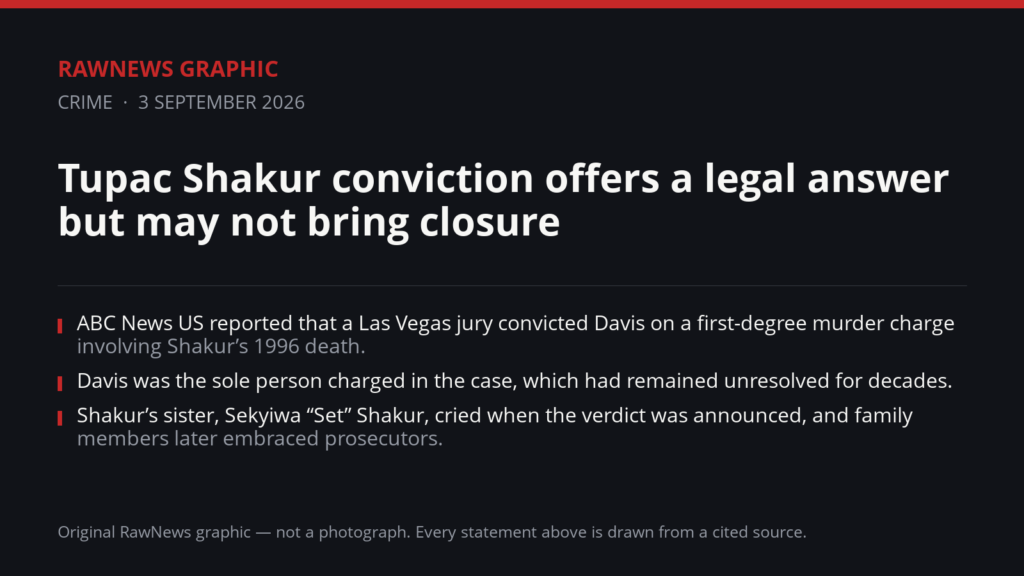
The conviction of Duane “Keffe D” Davis gives prosecutors a legal resolution in Tupac Shakur’s killing, but the verdict may not answer what closure means for the people affected. ABC News US reported that a Las Vegas jury convicted Davis on a first-degree murder charge involving Shakur’s 1996 death. Davis was the sole person charged in the case, which had remained unresolved for decades. Shakur’s sister, Sekyiwa “Set” Shakur, cried when the verdict was announced, and family members later embraced prosecutors.
The unresolved 1997 killing of Christopher Wallace, better known as The Notorious B.I.G., and continuing speculation about Shakur’s death have kept the era’s larger questions alive. Wolfson said prosecutors did not believe they had sufficient evidence to charge anyone else in Shakur’s death. When Davis was charged in 2023, Shakur’s sister described the development as important while emphasizing accountability rather than simply the passage of time.
Prosecutor Binu Palal likewise distinguished between Shakur as a public icon and Shakur as a beloved family member whose death caused a personal loss. Chuck Creekmur, co-founder of AllHipHop, said the family could gain some measure of closure even as theories about the killing continue. Creekmur’s assessment was that the verdict might close one part of the story while beginning another. Creekmur said the verdict could offer a limited form of closure without resolving every question, while veteran journalist Dave “Davey D” Cook viewed it as the end of one chapter in a larger story.
The prosecution presented the killing as retaliation tied to a personal conflict, rather than as a broad contest between rival coasts, gangs and record labels. Prosecutors said surveillance footage from the MGM Grand showed Shakur and members of his entourage beating Orlando “Baby Lane” Anderson hours before the shooting on Sept. 7, 1996. They argued that Davis obtained a gun, assembled a group that included Anderson and helped arrange the attack on Shakur and Death Row Records co-founder Marion “Suge” Knight. The case did not allege that Davis fired the fatal shots; prosecutors instead said he supplied the weapon and helped organize the assault.
Davis had spoken publicly for years about a killing that had not produced a prosecution, and those statements became important evidence for the state. Prosecutors cited material from interviews with investigators, documentaries, internet appearances and Davis’s 2019 memoir, Compton Street Legend. The defense maintained that his accounts had been embellished or invented for financial gain and notoriety. Clark County District Attorney Steve Wolfson said the prosecution’s case was strengthened by Davis’s own public statements.