

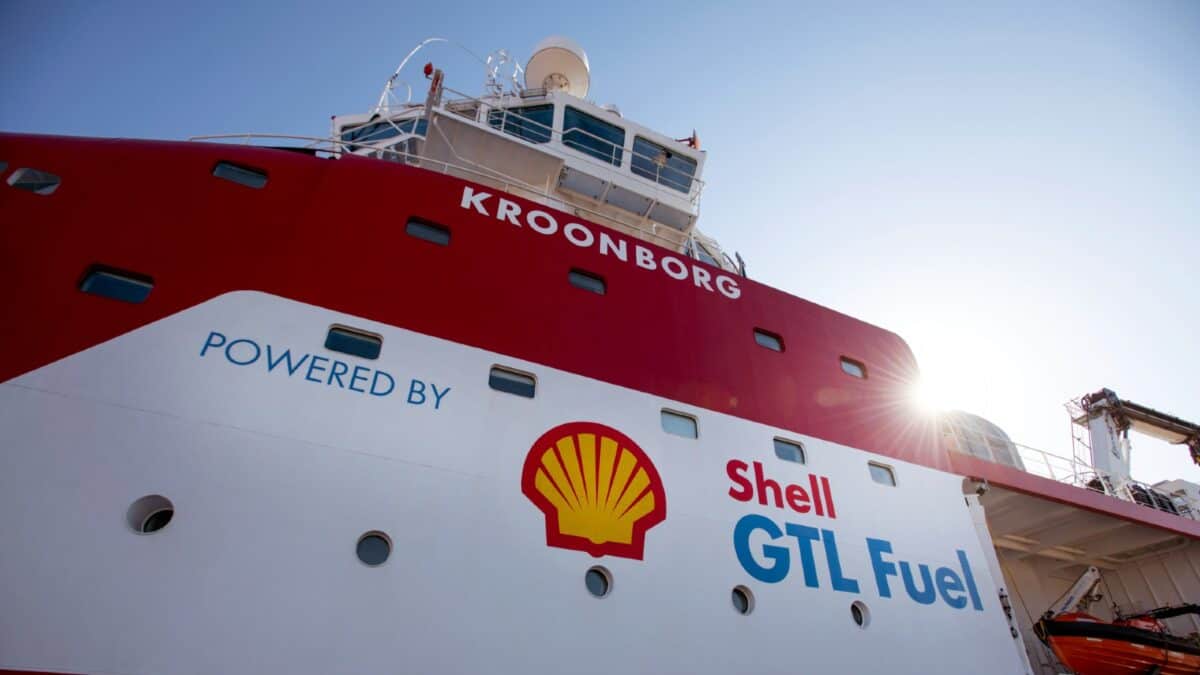
Image source: Olaf Kraak via Shell plc
Long-term holders of shares in Shell (LSE:SHEL) have done very well. Compared to April 2021, they are now (17 April) changing hands for an amazing 137% more. It means the 354 shares that a £5,000 investment would have bought five years ago, are presently worth an incredible £11,865.
Anyone spending £5,000 on the energy giant’s shares today would only be able to afford 149 of them. Does this mean it no longer makes sense to consider buying Shell’s stock? Let’s explore this further.
An unfortunate reality
It’s an uncomfortable truth that whenever there’s trouble in the Gulf region, Shell will be one of the beneficiaries. Unlike the vast majority of companies, soaring energy prices will boost its bottom line.
But commodity prices are impossible to predict with any accuracy. Their volatile nature means nobody knows with any certainty what Shell’s earnings are likely to be from one period to another.
Take the oil price as an example. Looking back to the start of 2005, the average monthly price of a barrel of Brent crude has varied from $18.38 (April 2020) to $132.72 (July 2008). Yes, it’s been over the psychologically important $100-mark during 55 of the past 255 months. But it’s also been below $55 in 50 of them.
Even so, the need for oil and gas, and the sheer size of Shell’s business, means that other than during the most exceptional of times – the pandemic is a recent example – it remains hugely cash generative.
From 2021-2025, it produced an enormous $265.3bn of cash from its operations.
But energy industry infrastructure is expensive and is often funded by borrowing. Indeed, the group’s net debt increased by $6.9bn to $45.7bn during 2025.
Not bad for income
In recent times, the group’s dividend has been pretty good.
From its adjusted earnings per share of $19.03 over the past five years, it’s returned $6.06 to shareholders. In cash terms, its 2025 payout was 62% higher than in 2021.
Although the recent surge in Shell’s share price has pushed its yield lower, the stock’s still paying 3.2%. This is slightly above that of the FTSE 100 as a whole.
However, it’s important to remember that dividends cannot be guaranteed.
My view
Although Shell is a reliable performer, I think there are better opportunities to consider elsewhere in the sector, like BP (LSE:BP).
Although it’s also affected by volatile energy prices and has a large debt pile, it’s part-way through a significant cost-cutting programme. And it’s selling some non-core assets to reduce borrowings.
Under shareholder pressure, BP’s actively seeking to address the fact that it has a lower margin than its larger rival and, even though it generates less revenue, it employs more people.
All companies in the sector will see their revenue move up or down in line with energy prices. But I think that BP, by becoming leaner and more efficient, will outperform Shell — relatively speaking — over the next few years.
And with a yield of 4.2%, its dividend is more generous.
On this basis, for investors who are comfortable with the sector, I think BP could be a stock to consider. But only by those who are prepared to take a long-term view and will be able to ignore the volatile nature of the group’s revenue and earnings.




