

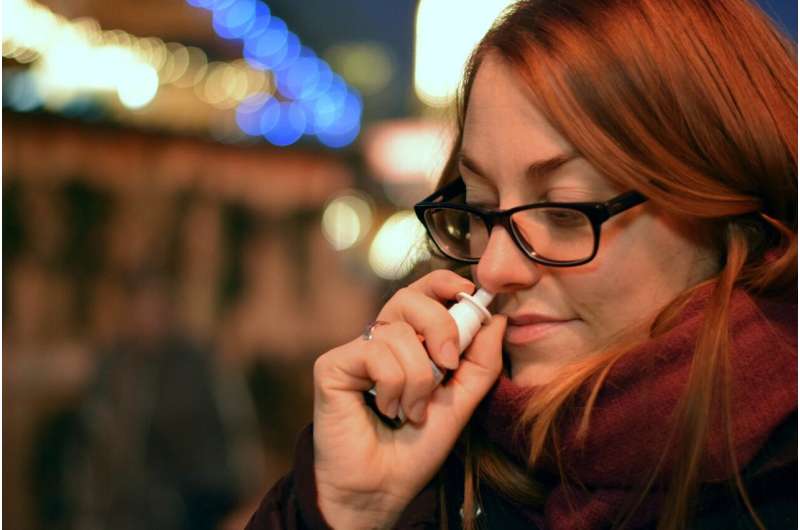
A research team at Saarland University has demonstrated in a clinical study that a widely used anti-allergy nasal spray containing the active ingredient azelastine can significantly reduce the risk of infection with the SARS-CoV-2 virus. The results of the placebo-controlled trial involving 450 healthy participants have now been published in JAMA Internal Medicine.
The trial, led by Professor Robert Bals, Director of the Department of Internal Medicine V at Saarland University Medical Center and Professor of Internal Medicine at Saarland University, divided the 450 participants into two groups. The treatment group of 227 individuals used an azelastine nasal spray three times a day over a 56-day period. During that same period, the 223 participants in the control group used a placebo spray three times a day.
Bals summarized the key finding as follows: “During the observation period, 2.2% of the participants in the azelastine group became infected with SARS-CoV-2; in the placebo group, it was 6.7%—three times as many.” All infections were confirmed by PCR testing.
In addition to showing a marked reduction in coronavirus infections, the azelastine group also displayed fewer symptomatic SARS-CoV-2 infections, a lower overall number of confirmed respiratory infections, and, unexpectedly, a reduced incidence of rhinovirus infections, another major cause of respiratory illness. In the treatment group, 1.8% developed a rhinovirus infection, compared to 6.3% in the placebo group—a proportion similar to that seen for SARS-CoV-2.
Azelastine nasal spray has been available for decades as an over-the-counter treatment for hay fever. Previous in vitro studies on azelastine had already suggested antiviral effects against SARS-CoV-2 and other respiratory viruses. “This clinical trial is the first to demonstrate a protective effect in a real-world setting,” says Professor Bals.
For Bals, the results suggest practical applications. “Azelastine nasal spray could provide an additional easily accessible prophylactic to complement existing protective measures, especially for vulnerable groups, during periods of high infection rates, or before traveling.”
But Professor Bals also stressed the importance of further research. “Our results highlight the need for larger, multicenter trials to continue exploring the use of azelastine nasal sprays as an on-demand preventive treatment, and to examine its potential effectiveness against other respiratory pathogens.”
Besides Professor Bals, the randomized, double-blind phase 2 study “CONTAIN” also involved the Institute of Clinical Pharmacy (Professor Thorsten Lehr, Dr. Dominik Selzer), the Institute of Virology (Professor Sigrun Smola), and the Saarbrücken-based pharmaceutical company URSAPHARM Arzneimittel GmbH, which sponsored the study and manufactured the investigational product.
More information:
Thorsten Lehr et al, Azelastine Nasal Spray for Prevention of SARS-CoV-2 Infections, JAMA Internal Medicine (2025). DOI: 10.1001/jamainternmed.2025.4283
Citation:
Widely available nasal spray reduces risk of coronavirus infection by two-thirds, clinical study suggests (2025, September 2)
retrieved 2 September 2025
from https://medicalxpress.com/news/2025-09-widely-nasal-spray-coronavirus-infection.html
This document is subject to copyright. Apart from any fair dealing for the purpose of private study or research, no
part may be reproduced without the written permission. The content is provided for information purposes only.




