

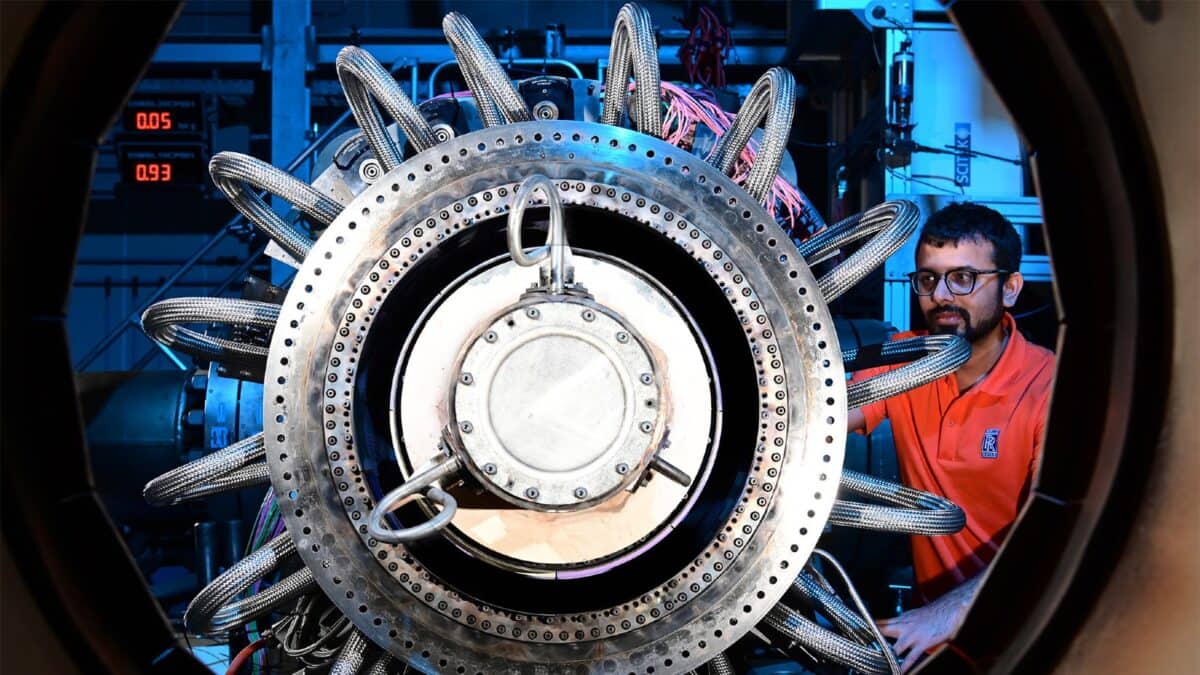
Image source: Rolls-Royce Holdings plc
Much has been written about Rolls-Royce Holdings‘ (LSE:RR.) shares over the past few years. Indeed, the astonishing post-pandemic recovery in its share price has been incredible to watch and worthy of plenty of headlines.
At the end of November 2020, just after the aerospace and defence group’s life-saving £2bn rights issue was completed, its shares were changing hands for £1.06. Today (16 April), they’re fetching £12.92. Ignoring dividends, that’s an overall return of 1,119%.
No more to say as those figures speak for themselves. However, there’s lots to say about the group’s future. So here goes…
A key contributor
What I’m most excited about is Rolls-Royce’s civil aviation business. In 2025, this division contributed 51.8% (£10.4bn) of revenue and 61.5% (£2.1bn) of operating profit (both reported on an underlying basis). At 20.5%, this part of the group had the highest operating margin.
These numbers suggest that Rolls-Royce knows what it’s doing when it comes to manufacturing and maintaining aircraft engines. But it’s the future I want to look at. At the moment, the group focuses exclusively on widebody planes. However, it wants this to change.
A different approach
When reporting last year’s results, the group said: “We also see an opportunity to re-enter the large and growing narrowbody market, which offers attractive synergies to our existing widebody and business aviation activities, based on our UltraFan technologies”.
And I reckon the potential is enormous. According to latest (June 2025) figures from the International Air Transport Association (IATA), there are 30,300 active aircraft in the world. Of these, 18,495 are single-aisle planes and 5,869 are larger ones. The rest are turboprops and small jets.
What’s more, at December 2025, it’s estimated that there was an order backlog of 17,000 aircraft. This has doubled in the past few years.
With relatively little competition — there are only four companies making aeroplane engines at the moment – its UltraFan technology is proving to be 25% more fuel efficient than the group’s first-generation Trent engine. So the scale of its aviation business could be transformed if all goes to plan.
And why wouldn’t it make a success of it? It already powers a third of the world’s widebody fleet.
Some challenges
However, there are risks. The group’s shares are trading at 30 times forecast (2028) earnings. Any sign that these expectations will not be met and there could be a sharp correction in the group’s share price. Given that the business is exposed to global aviation cycles and macroeconomic shocks, this could happen.
Investors also appear to have placed significant value on its small modular reactor programme. However, this has yet to be proven to be commercially viable.
My view
Despite these issues, I think the group’s in good shape and well positioned to take its operations to another level. However, patience is required. The first revenue from its single-aisle UltraFan engine is not anticipated until the early 2030s.
Until then, its defence division’s likely to continue growing as a result of increased global uncertainty. Also, I suspect the requirement for new data centres will help expand its power systems business.
Despite its lofty valuation, I still think Rolls-Royce is a stock for long-term investors to consider. There, I’ve said it.




