

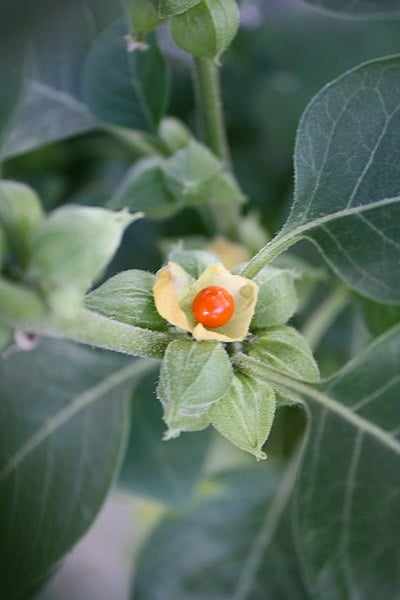
 When I was in herb school one of our assignments was to prepare and take one medicinal herb for a week and document its effects. We’d discussed herbs to support healthy sleep in class, and as a person with life-long sleep issues I picked a plant from this category – ashwagandha. The traditional way to prepare ashwagandha is to simmer it in milk and drink it before bed. While the warm milk sorta grossed me out, the way this plant helped me fall – and stay- asleep earned it a spot on my top ten favorite herbs.
Ashwagandha (Withania somnifera) is an Old World nightshade in the family Solanaceae, but it seems to have escaped the veil of superstition and suspicion that surrounds its more notorious cousins such as henbane and deadly nightshade. Its range extends from the Mediterranean to South and East Africa, over to the Middle East and into India and Sri Lanka. It’s a small branching shrub, growing two to three feet tall and producing small red fruits surrounded by a lantern-like calyx (think tiny Chinese lanterns or tomatillos, which are also nightshades.) The common name translates from Sanskrit to mean “smells like a horse,” referring to the strong odor of the root. It could also suggest the effects of taking ashwagandha, which may give one “the power of a horse” (Singh, Bhalla, de Jager, and Gilca, 2011). The specific epithet, somnifera, alludes to the herb’s sleep-promoting properties.
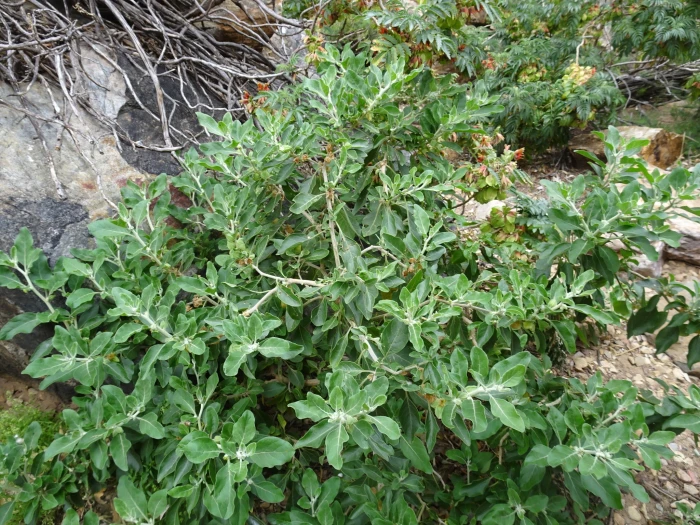 This plant has a long history of use in Ayurvedic medicine, likely going back 6000 years. There is evidence dating to at least 1000 B.C.E of the scholar Punarvasu Atreya teaching medical students how to use it (Singh and Kuma, 1998). A plant that is commonly accepted to be ashwagandha appears in the oldest surviving copy of Dioscorides’s De Materia Medica from the 6th century, and then again in texts from the 1550s under names like Solanum somniferum verticilliatum, Solanum soporiferum, and Thrychnos hypnoticos – names that, again, refer to its sleep-inducing properties, as well as its relationship to other nightshades (Daunay, Laterrot, and Janick, 2008). In Ayurveda, ashwagandha is considered a Rasayana, a “therapeutic measure which promotes the [sic] longevity, prevents aging, provides positive health and mental faculties, increases memory, and impart[s] resistance and immunity against diseases” (National Health Portal, 2016). The root is used for malnutrition, insomnia, and anxiety, and as an aphrodisiac, diuretic, general tonic, and adaptogen (a category of plants that help one cope with physical, chemical, and emotional stressors). In Africa, various peoples use the root to improve uterine tone, as a nervine, and for asthma; leaves are applied to boils, eye sores, and open wounds (Singh, Bhalla, de Jager, and Gilca, 2011; Singh and Kuma, 1998).
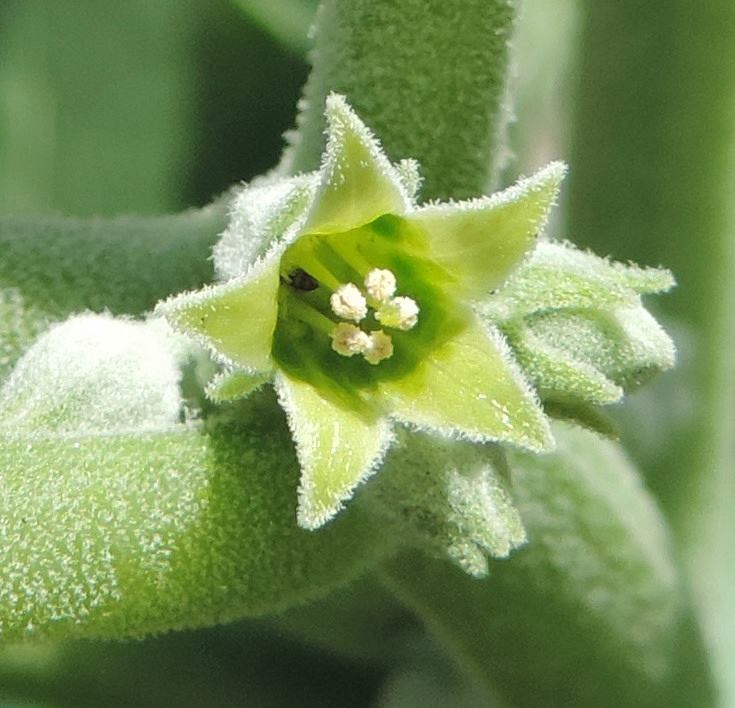 Unlike many other solanaceous plants that can attribute their therapeutic properties to alkaloids, the main active constituents in ashwagandha are a group of steroidal lactones called withanolides. These are responsible for the antimicrobial and adaptogenic actions of ashwagandha and also demonstrate anti-cancer and anti-inflammatory activities (Dar, Hamid, and Ahmad, 2015). Discovery of these compounds and their therapeutic actions supports how this plant has traditionally been used. These steroidal lactones are also responsible for the herb’s fabled fragrance (Wal and Wal, 2013). I, for one, gladly tolerate any equine odors to take advantage of ashwagandha’s horsepower.
The post The Horsepower of Ashwagandha first appeared on The Herb Society of America Blog.




