

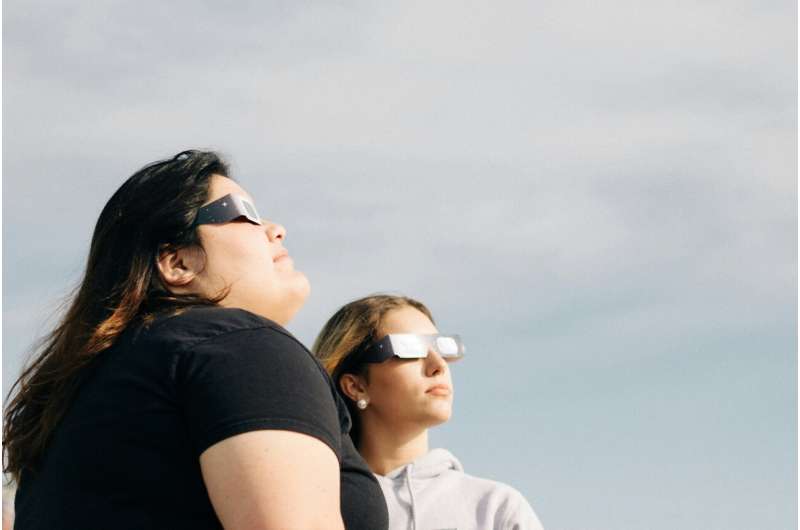
On April 8, 2024, a once-in-a-lifetime total solar eclipse kept the eyes of millions of Quebecers riveted on the sky. But the experience left at least two among them—a 34-year-old man and a 17-year-old woman—with permanent retinal damage. They’d been gazing directly at the sun without wearing any protective eyewear.
The two cases were identified through a special registry set up by Quebec’s Association of Ophthalmologists (AMOQ) for its 350 members to report any adverse ocular events following the eclipse.
A team of retinal specialists from the Centre hospitalier de l’Université de Montréal (CHUM) confirmed the two cases, and last month, wrote up a detailed account published in the Canadian Journal of Ophthalmology.
Through a window and with one eye
In each recorded case, the individuals were not wearing certified protective eyewear while observing the eclipse.
The 34-year-old man watched it through a window for about 30 seconds. He sought medical attention 25 days later for blurred vision and spots in the visual field of both eyes.
The 17-year-old woman covered her right eye with her hand while looking at the eclipse. She consulted an ophthalmologist three weeks later for persistent vision problems in her left eye.
In both cases, subsequent examination and testing by ophthalmologists revealed lesions in the patients’ fovea, the central part of the retina responsible for sharp, detailed vision.
“The retina is the film that captures light and enables us to see,” explained Fares Antaki, a CHUM ophthalmologist. “When we look at the sun without protection, ultraviolet rays can damage the retina’s photoreceptor cells. Often, the damage is irreversible, but its severity can vary depending on the duration of exposure, weather conditions, and the specific anatomy of the patient’s eye.”

Lasting damage
In both cases seen by the CHUM, the individuals had near-normal visual acuity immediately after observing the eclipse but were left with lasting structural damage to the eye.
According to the study, examination of the 34-year-old man “showed loss of the ellipsoid zone, accompanied by a subtle curvilinear column of hyperreflective Henle fibers in both eyes.”
In the case of the 17-year-old woman, tests showed the left eye had “an outer hyporeflective space indicative of ellipsoid and interdigitation zone loss.”
In both cases, therefore, there was significant cellular-level damage, even though the short-term symptoms were relatively mild.
“It’s clear there are lasting after-effects because the photoreceptors were damaged,” noted Antaki.
Probably many more
Only two cases in an overall population of 9.1 million Quebecers may appear minimal. But Antaki is not surprised; he believes the actual number is probably much higher.
“Our methodology relied solely on self-reporting by ophthalmologists, which could have led to underestimating the total number of cases,” he said. “We also didn’t have any data from optometrists, and some people (who looked at the eclipse) may not have sought any help at all.”
Antaki also highlighted the positive impact of awareness campaigns conducted before the eclipse.
“I think there was a very good effort and it was entirely justified; there was extensive coverage on TV, in print media and on social media,” he said, adding that this probably helped prevent many more cases of solar retinopathy.
“We need to keep finding creative ways to raise awareness about eye health. For young people, this could be through social media; for seniors, it could be TV, radio or print media, since not everyone has access to digital technology.”
The campaigns will have to be repeated for future eclipses, he added—even though another total eclipse of the sun here is a long way away. Quebec won’t see another one until four generations from now, in 2106.
More information:
Fares Antaki et al, Solar retinopathy following the April 2024 eclipse in Quebec, Canada, Canadian Journal of Ophthalmology (2024). DOI: 10.1016/j.jcjo.2024.10.006
Citation:
The price of a peek: Retinal damage after the 2024 solar eclipse (2025, June 4)
retrieved 5 June 2025
from https://medicalxpress.com/news/2025-06-price-peek-retinal-solar-eclipse.html
This document is subject to copyright. Apart from any fair dealing for the purpose of private study or research, no
part may be reproduced without the written permission. The content is provided for information purposes only.




