

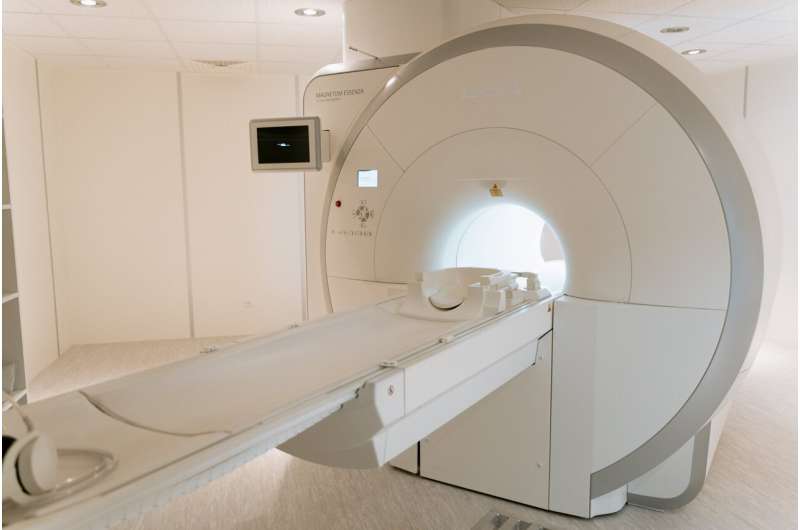
A team led by Eamon Doyle, Ph.D., in the Borzage Laboratory at Children’s Hospital Los Angeles developed novel computational models for magnetic resonance imaging. These models enable more accurate imaging of cerebral blood flow in children and adults while compensating for missing imaging data.
Their findings were published in the journal Frontiers in Physiology.
Human error, patient movement, or anatomical variations in intricate vessel structures can create challenges in acquiring imaging information to accurately quantify the blood flow in the brain.
“It’s pretty unlikely you’ll get all four blood vessels of the brain perfectly,” says Dr. Doyle, lead study author. “The technician may not notice, depending on how severe the error is.”
Impairments in cerebral blood flow can signal hidden brain injuries or diseases. “Our goal was to develop mathematical models to estimate cerebral blood flow for a wide age range of patients whenever one or more vessels are not correctly measured,” says Dr. Doyle.
The researchers used a set of 258 phase-contrast MRIs from a group of 108 children and 88 adults, comparing results with a control group. The pediatric cohort included patients with seizures and epilepsy, as well as tumors. The researchers examined blood flow by age, blood vessel condition, and quality of blood flow.
“These models show that you can effectively repair and use the data, even if you have only a partial data set,” says Matthew Borzage, Ph.D., corresponding author.
“You can also extend this to patients who may have pathological blood flow.” He adds that specialized equipment is generally used for brain imaging, but these computational models could potentially enable clinicians to use the standard 3T phase contrast MRI—used to image the heart—to assess the tiny vessels of the brain.
The next steps would be to automate the analysis to allow real-time corrections of imaging errors. “One of the strengths of this study is that we used a heterogeneous group of kids and adults to help us learn more about overall patterns in the population,” says Dr. Borzage.
“We can do a smashingly good job of getting those blood flow numbers to look for anomalies and get richer interconnections between the data to improve diagnosis.”
More information:
Eamon K. Doyle et al, Imputation models and error analysis for phase contrast MR cerebral blood flow measurements in heterogeneous pediatric and adult populations, Frontiers in Physiology (2025). DOI: 10.3389/fphys.2025.1527093
Citation:
Mathematical models help correct errors in MRI brain blood flow imaging (2025, August 8)
retrieved 8 August 2025
from https://medicalxpress.com/news/2025-08-mathematical-errors-mri-brain-blood.html
This document is subject to copyright. Apart from any fair dealing for the purpose of private study or research, no
part may be reproduced without the written permission. The content is provided for information purposes only.




