

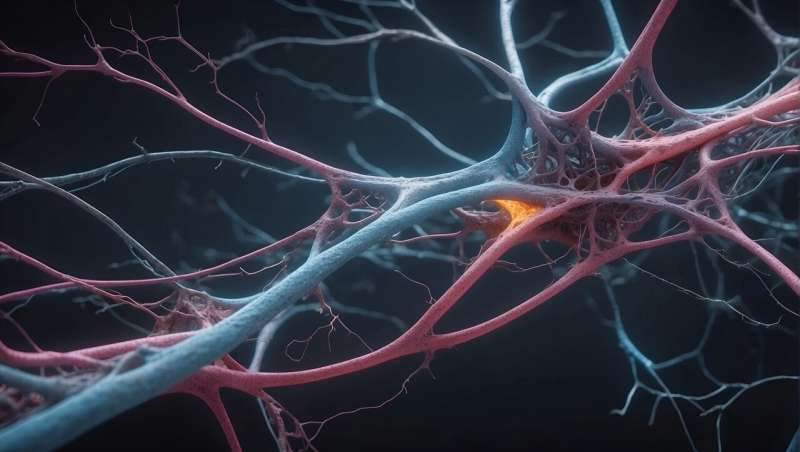
For decades, neuroscientists have developed mathematical frameworks to explain how brain activity drives behavior in predictable, repetitive scenarios, such as while playing a game. These algorithms have not only described brain cell activity with remarkable precision but also helped develop artificial intelligence with superhuman achievements in specific tasks, such as playing Atari or Go.
Yet these frameworks fall short of capturing the essence of human and animal behavior: our extraordinary ability to generalize, infer and adapt. Our study, published in Nature late last year, provides insights into how brain cells in mice enable this more complex, intelligent behavior.
Unlike machines, humans and animals can flexibly navigate new challenges. Every day, we solve new problems by generalizing from our knowledge or drawing from our experiences. We cook new recipes, meet new people, take a new path—and we can imagine the aftermath of entirely novel choices.
It was in the mid-20th century that psychologist Edward Tolman described the concept of “cognitive maps”. These are internal, mental representations of the world that organize our experiences and allow us to predict what we’ll see next.
Starting in the 1970s, researchers identified a beautiful system of specialized cells in the hippocampus (the brain’s memory center) and entorhinal cortex (an area that deals with memory, navigation, and time perception) in rodents that form a literal map of our environments.
These include “place cells,” which fire at specific locations, and “grid cells” that create a spatial framework. Together, these and a host of other neurons encode distances, goals and locations, forming a precise mental map of the physical world and where we are within it.
Now our attention has turned to other areas of cognition beyond finding our way around generalization, inference, imagination, social cognition and memory. The same areas of the brain that help us navigate in space are also involved in these functions.
Cells for generalizing?
We wanted to know if there are cells that organize the knowledge of our behavior, rather than the outside world, and how they work. Specifically, what are the algorithms that underlie the activity of brain cells as we generalize from past experience? How do we rustle up that new pasta dish?
We did find such cells. There are neurons that tell us “where we are” in a sequence of behavior (we haven’t named the cells).
To uncover the brain cells, networks and algorithms that perform these roles, we studied mice, training the animals to complete a task. The task had a sequence of actions with a repeating structure. Mice moved through four locations, or “goals,” containing a water reward (A, B, C and D) in loops.
When we moved the location of the goals, the mice were able to infer what came next in the sequence—even when they had never experienced that exact scenario before.
When mice reached goal D in a new location for the first time, they immediately knew to return to goal A. This wasn’t memory, because they’d never encountered it. Instead, it shows that the mice understood the general structure of the task and tracked their position within it.
The mice had electrodes implanted into their brains, which allowed us to capture neural activity during the task. We found that specific cells in the cortex (the outermost layer of the brain) collectively mapped the animal’s goal progress. For example, one cell could fire when the animal was 70% of the way to its goal, regardless of where the goal was or how far away.
Some cells tracked progress towards immediate subgoals—like chopping vegetables in our cooking analogy—while others mapped progress towards the overall goal, such as finishing the meal.
Together, these goal progress cells created a system that gave us our location in a behavioral space rather than in a physical space. Crucially, the system is flexible and can be updated if the task changes. This encoding allows the brain to predict the upcoming sequence of actions without relying on simple associative memories.
Common experiences
Why should the brain bother to learn general structural representations of tasks? Why not create a new representation for each one? For generalization to be worthwhile, the tasks we complete must contain regularities that can be exploited—and they do.
The behavior we compose to achieve our goals is replete with repetition. Generalization allows knowledge to extend beyond individual instances. Throughout life, we encounter a highly structured distribution of tasks. Each day we solve new problems by generalizing from past experiences.
A previous encounter with making bolognese can inform a new ragu recipe, because the same general steps apply to both (such as starting with frying onions and adding fresh herbs at the end). We propose that the goal-progress cells in the cortex serve as the building blocks—internal frameworks that organize abstract relationships between events, actions and outcomes. While we’ve only shown this in mice, it is plausible that the same thing happens in the human brain.
By documenting these cellular networks and the algorithms that underlie them, we are building new bridges between human and animal neuroscience, and between biological and artificial intelligence—and pasta.
This article is republished from The Conversation under a Creative Commons license. Read the original article.
Citation:
How researchers discovered specific brain cells that enable intelligent behavior (2025, May 1)
retrieved 1 May 2025
from https://medicalxpress.com/news/2025-05-specific-brain-cells-enable-intelligent.html
This document is subject to copyright. Apart from any fair dealing for the purpose of private study or research, no
part may be reproduced without the written permission. The content is provided for information purposes only.




