


Image source: Getty Images
Owning high-quality UK shares can help investors build substantial passive income in retirement. But with markets exhibiting significant volatility recently, many investors are stepping aside and hiding in cash. Is this a costly mistake?
Time in the market
Not everyone has £10,000 available to invest as a lump sum. But the principle remains the same: over long time horizons, investing has historically outperformed holding cash.
Yet in periods of heightened volatility, many investors hesitate to invest and instead allow cash to sit on the sidelines. Over time, that caution can quietly turn into a habit — with money only being invested later, rather than immediately.
One common example of this is waiting until the end of each ISA season before putting money to work. While it may feel harmless in the short term, this repeated delay can have a meaningful impact on long-term portfolio growth.
£41k boost
The chart below illustrates this clearly. A £10,000 annual investment into a Stocks and Shares ISA over 20 years produces a noticeable difference in final portfolio value depending on when the money is invested.
Although the return assumption of 9% is identical in both scenarios, small differences in timing compound significantly over long periods. In this example, the gap builds to around £41,000.
To put that into context, using the 4% withdrawal rule, a portfolio of roughly £553,000 could generate around £1,845 a month in passive income.
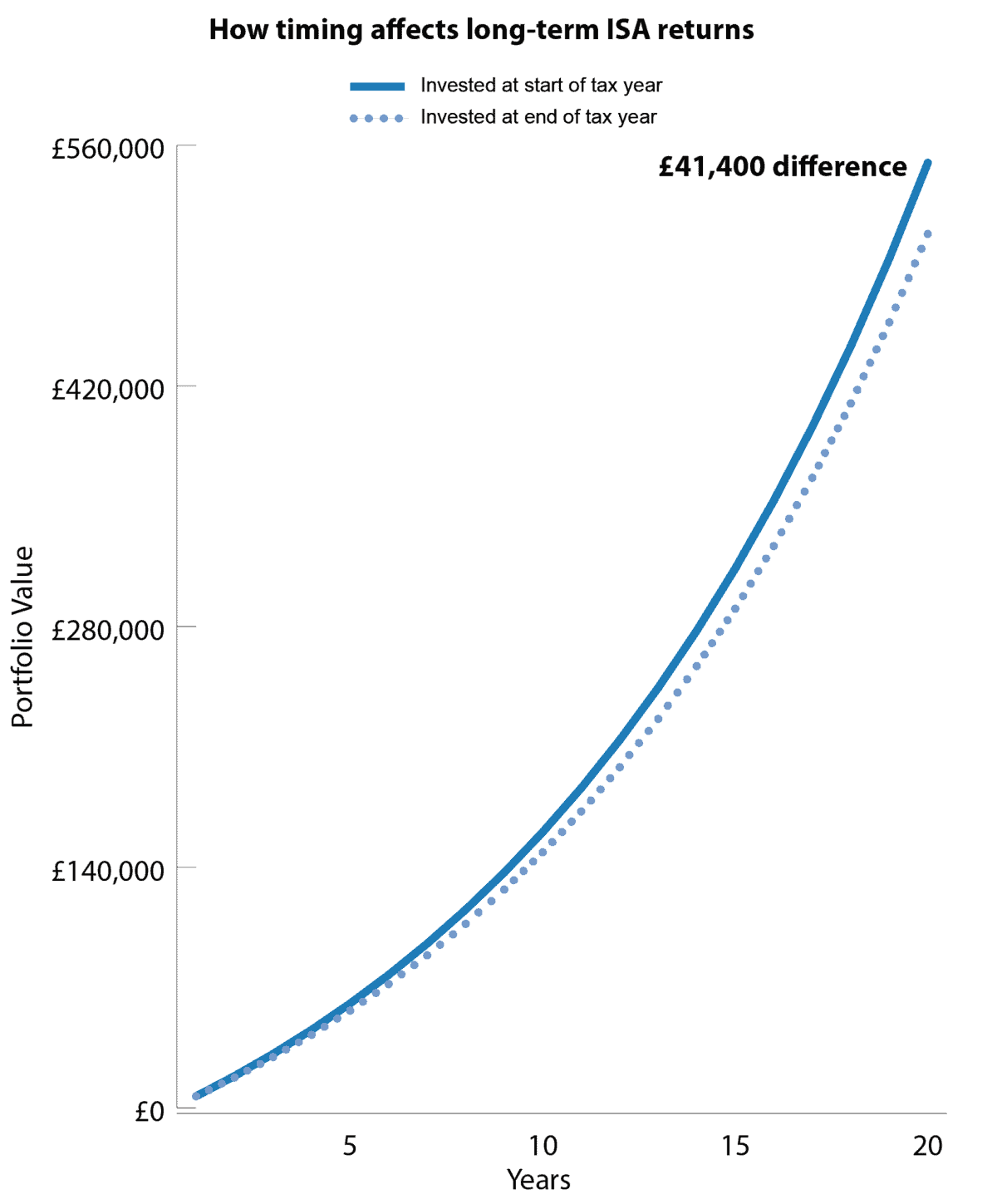
Chart created by author
Where volatility creates opportunity
Periods of market hesitation don’t just affect when investors buy — they can also influence what they choose to buy.
When uncertainty rises, many investors step away from the market entirely, but others simply avoid certain sectors they believe are too exposed to volatility. That can create short-term mispricing in high-quality businesses that ultimately continue to generate strong cash flows over time.
An example is BP (LSE: BP.), which has seen investor sentiment swing sharply in recent years as energy markets, geopolitics, and strategy shifts have driven significant volatility in its share price.
Strong cash flows
One point often overlooked is that despite strategic missteps in its low-carbon transition and associated write-downs, BP has remained a significant cash-generating business.
The figures below highlight this clearly:
| Financial metric | 2021 | 2022 | 2023 | 2024 | 2025 |
| Free cash flow ($m) | 13,870 | 29,572 | 17,887 | 12,328 | 12,414 |
| FCF dividend cover | 3.22 | 6.79 | 3.72 | 2.46 | 2.45 |
Last year, amid weak oil prices, the company still generated significant free cash flow, more than enough to support its growing dividend.
With prices now stronger, the business also has greater scope to accelerate balance sheet deleveraging than previously expected.
The new management team has already signalled a move towards simplification, with a sharper focus on its core upstream and downstream operations.
Of course, the business remains highly sensitive to oil prices, and a sharp fall — for example, if geopolitical tensions ease materially — would present a clear risk.
But oil markets have always been cyclical and volatile. For long-term investors, the key question is not short-term direction, but whether the underlying cash generation remains durable over time. With global energy demand still structurally supported, the current environment may be offering long-term investors an opportunity, even after the recent strength in the share price.




