

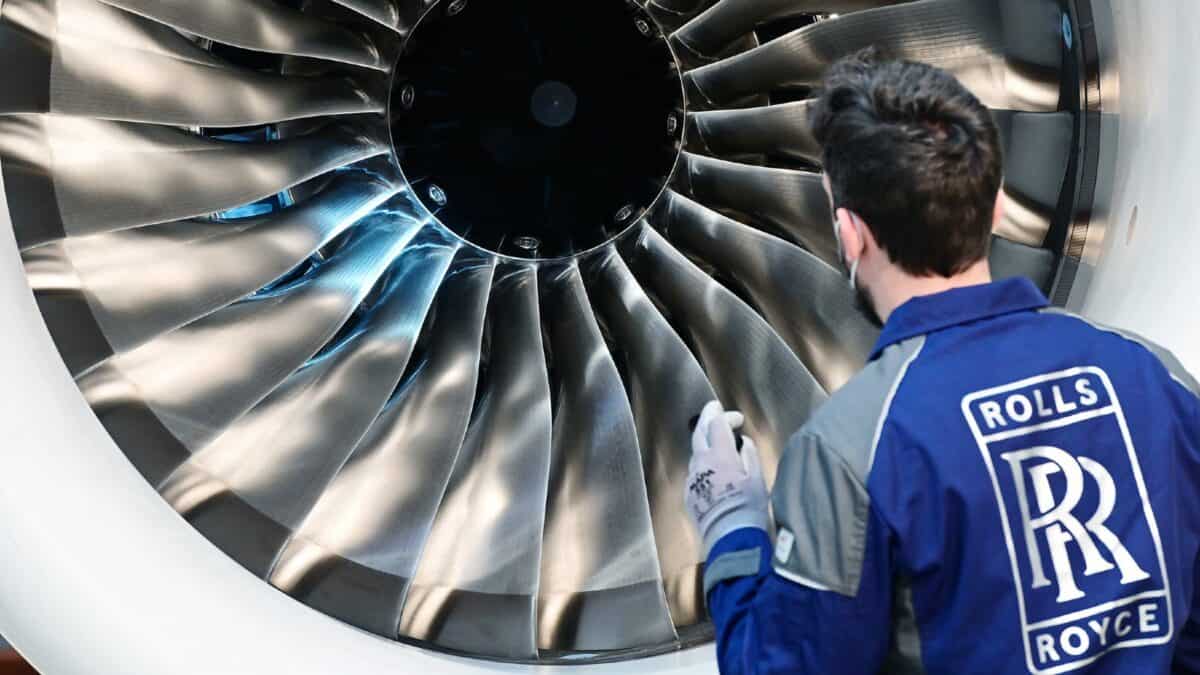
Image source: Rolls-Royce plc
Rolls-Royce (LSE:RR) shares nosedived 6.3% yesterday (21 April). This easily made the engine maker the worst-performing stock in the FTSE 100.
The fact that Melrose Industries was the second-worst performer (down 4.2%) tells us that this was a sector-wide concern across aerospace and defence. Both have continued falling today, with Rolls down a further 3%, as I type.
Let’s take a look at what has caused this sudden sell-off.
3 emerging risks
The catalyst was GE Aerospace (NYSE:GE), which yesterday released its Q1 results. Now, the quarter itself looked very solid to me, with adjusted revenue growing 29% to $11.6bn. The engine maker also saw an 87% increase in total orders, to $23bn.
Meanwhile, adjusted earnings per share (EPS) of $1.86 beat Wall Street expectations. Free cash flow increased by 14% to $1.7bn.
However, there were three issues that seemed to spook investors, and might have implications for Rolls-Royce moving forward this year.
First, GE lowered its outlook for global flight departures, saying it now expected growth to be flat-to-low-single digits, down from mid-single-digits previously. This is due to the ongoing conflict in Iran, which is causing major flight disruptions and cancellations across the Middle East.
Chief executive H. Lawrence Culp, Jr. euphemistically called this a “dynamic geopolitical landscape“.
Second, management warned that the price of Brent crude oil is expected to stay elevated through the third quarter. Obviously, higher fuel costs squeeze the margins of GE’s core customers — the airlines — which leads to cancelled routes and possibly even delayed new orders.
Finally, even though GE did really well in Q1, it did not raise full-year guidance. Management said it was “trending toward the high end” of its earnings target. So while Q1 numbers were strong, the message underneath was more cautious.
GE said its guidance “does not assume a global economic recession“. All guidance essentially goes out the window if that occurs.
What about Rolls-Royce?
So, where does this leave Rolls-Royce then? Well, we have a rival flagging flight cancellations, surging fuel costs, and potential risk from a global economic downturn. We might therefore see more turbulence when the FTSE 100 company next reports.
Of course, such things are largely out of Rolls’ control, and this is always worth remembering. Cyclical travel demand and left-field events like the pandemic can quickly hurt engine flying hours, which are what drive the bulk of the firm’s revenue.
Adding to the risk is that both stocks still trade at a premium. Rolls’ forward price-to-earnings multiple is around 30, while GE looks very dear at 41.
Taking the long view
While still not cheap, Rolls is certainly getting more interesting after losing over 16% of its value in the past few weeks. Because over the long run, the firm’s growth prospects appear undimmed.
It has a clear opportunity to increase its installed base of engines, including in defence, while its small modular reactor (SMR) business has secured contractual certainty to build Europe’s first SMR fleet. The company also plans to re-enter the narrowbody (single-aisle) market.
Rolls-Royce already forms a large part of my ISA portfolio, so I’m not looking to buy more shares. But for investors who don’t currently hold the stock, I think it’s worth considering as a dip-buying opportunity.




