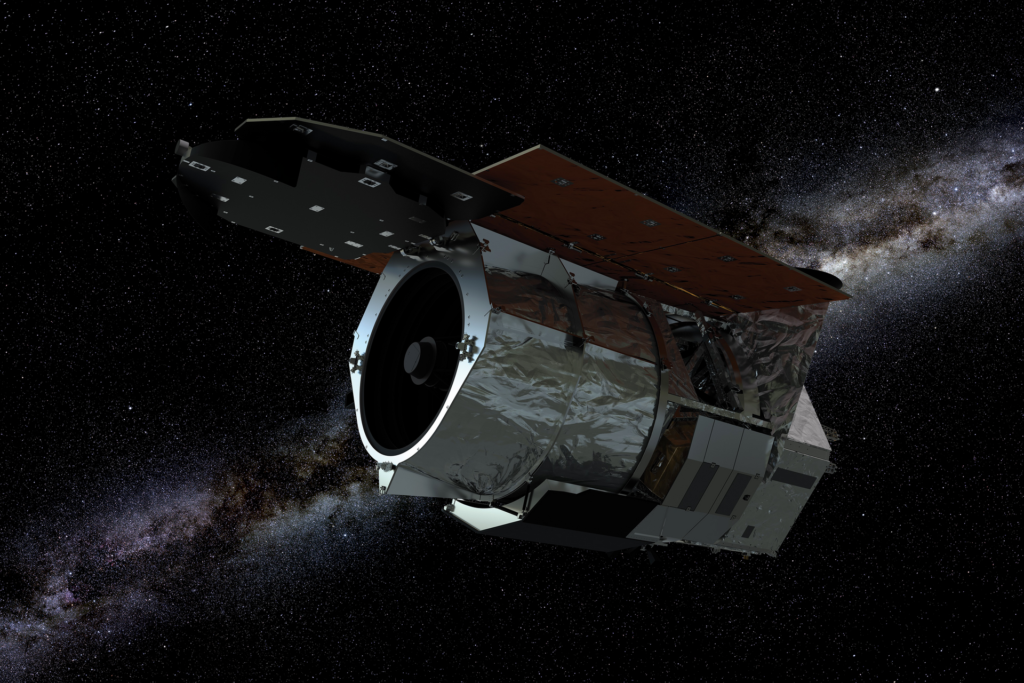
The Roman Space Telescope carries a primary mirror nearly 8 feet (2.4 meters) across, matching Hubble’s size but coming from surplus spy-satellite hardware. The National Reconnaissance Office gave NASA two unused mirrors more than a decade ago, with the second still in storage.
Fortune reported that SpaceX launched NASA’s $4.3 billion Roman Space Telescope aboard a triple-the-firepower Falcon Heavy rocket. The observatory is traveling toward a position 1 million miles (1.6 million kilometers) away, where the Webb Space Telescope is also located. Roman is expected to need more than three months to reach that destination.
A wider and faster survey
Its field of view will be more than 100 times wider than NASA’s Hubble Space Telescope, which has remained in orbit for 36 years. NASA expects the observatory to examine planets around other stars and investigate dark matter and dark energy. Astronomers expect Roman’s galaxy catalog to help them assess how the universe’s expansion is affected by those unseen forces.
NASA science mission director Nicky Fox said the telescope could identify thousands of supernovae, tens of thousands of planets, billions of galaxies and tens of billions of stars. Roman’s wide survey capability is intended to locate unusual and rare objects, after which the more sensitive Webb can study newly identified worlds in greater detail. Its infrared camera has Hubble-level sensitivity while scanning 1,000 times faster, according to the source material. A month of Roman observations of the Milky Way would take Hubble a century, Julie McEnery said.
Roman also carries an experimental coronagraph designed to suppress starlight and enable direct images of faint planets around masked stars. The telescope is not designed to look for life, but Fox said its work could support later observatories examining whether another Earth exists.
Launch and legacy
The launch included the successful return of Falcon Heavy’s two reusable side boosters to Cape Canaveral, followed by Roman’s separation from the rocket’s upper stage. NASA Administrator Jared Isaacman received a congratulatory call from President Donald Trump during a news conference after the launch.
The observatory will work alongside Hubble, Webb, the European Space Agency’s Euclid spacecraft and the National Science Foundation’s Vera C. Rubin Observatory in Chile. Roman was named for Nancy Grace Roman, NASA’s first chief astronomer, who joined the agency in 1959 and died in 2018 at age 93. Ed Weiler, who hired Roman in 1978, said the recognition was overdue and described her as the Mother of Hubble.
The telescope launched nearly a year ahead of schedule and within budget, and it is NASA’s first space telescope named after a woman. Roman is designed for refueling, so its operating life could be extended if a robotic tanker becomes available in the coming decade.