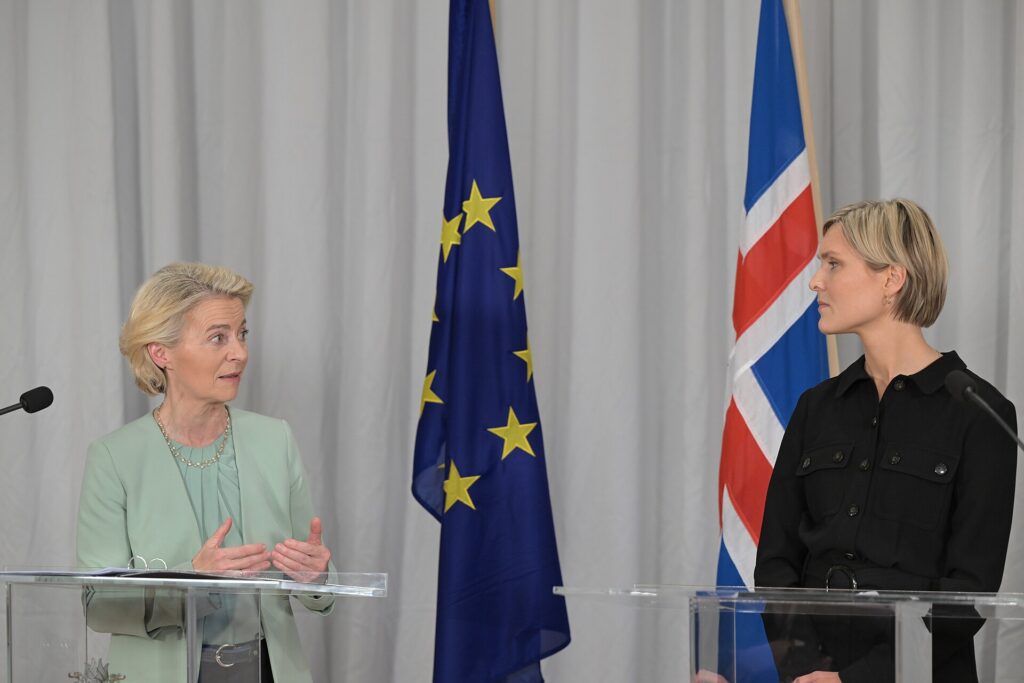
Fortune reported, citing RUV, that Iceland’s fishing industry was central to the referendum debate.
The industry led opposition over concerns that the European Union’s common fisheries policy could allow Spanish, Dutch and other trawlers into Icelandic waters. Opponents also said Iceland already benefits from the EU’s single market and the Schengen free-travel zone without accepting the sovereignty compromises of full membership. Supporters argued that membership could reduce inflation and interest rates, while the euro would offer more stability than Iceland’s volatile króna.
Iceland’s voters rejected a proposal to restart negotiations to join the European Union, more than a decade after earlier talks ended. Opponents won 52.8% of the vote, compared with 47.2% for the measure. Reykjavik was the only area where most voters backed restarting the talks.
Turnout exceeded 82% of the eligible 270,000 voters. The vote took place Saturday amid repeated threats by U.S. President Donald Trump to control nearby Greenland. Iceland’s left-leaning coalition government, elected in 2024, had moved the referendum forward from next year.
Voters were asked whether Iceland should resume accession negotiations with the European Union. Prime Minister Kristrún Frostadóttir, who supported the measure, said she hoped the result would not split the country.
Approval would have been only a preliminary step toward reviving negotiations with the European Commission, and voters would still have had to approve any final agreement. The outcome is expected to disappoint many in the European Union, according to the report. Iceland could have joined the bloc relatively quickly, with Croatia the last country to enter in 2013.
Other candidates, including countries in the Balkans, Moldova and Ukraine, still face reforms to align their laws and standards with those of the EU. Fortune reported that Iceland joining Europe’s rich club, potentially alongside Montenegro and Moldova, could have helped address the damage caused by Britain’s departure in 2020.