

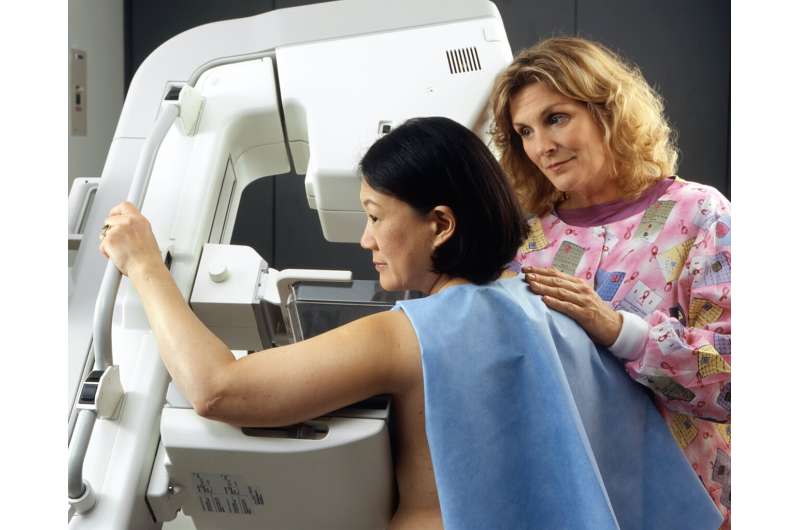
Breast cancer is the most commonly diagnosed form of cancer in the world among women, with more than 2.3 million cases a year, and continues to be one of the main causes of cancer-related mortality. Precisely predicting whether this type of tumor will reappear remains one of the key challenges in oncology.
To try and make progress in this field, an international team led by the Universitat Rovira i Virgili has developed an artificial intelligence model that brings together medical imaging data and clinical information to calculate the risk of tumor recurrence in a much more accurate and interpretative way.
The work is published in Lecture Notes in Computer Science.
The new system combines two sources of information, namely dynamic magnetic resonance imaging with contrast and the clinical data of each patient. Unlike existing systems, which only analyze the specific characteristics of the tumor, this new approach also takes into account other variables such as the surrounding breast tissue.
This global view allows the model to capture very subtle patterns, such as symmetry between the two breasts or the internal texture of the tumor, which are associated with a higher probability of relapse.
The model works completely automatically: first it segments the resonance images, then it selects the most relevant characteristics (shape, intensity and tissue variations), before finally combining this information with medical data such as the type of tumor, the status of the hormone receptors or the degree of malignancy.

All these elements are processed with a neural network model called TabNet, which is notable for its ability to analyze and interpret complex data.
In tests carried out on more than 500 patients, the model achieved a high level of overall accuracy—among the highest out of all the models tested so far—and demonstrated a greater ability to identify cases with a real risk of relapse.
“This sensitivity is key, as it allows us to reduce false negatives and prevents us from overlooking patients who may need monitoring or additional treatment,” explains Domènec Puig, the project’s principal investigator.
Analysis of the results has also identified the most important factors involved in making a prediction: the (irregular) texture of the tumor, the symmetry (or lack thereof) between the two breasts and the status of the hormone receptors. These indicators have the potential to become useful new visual and medical tools in clinical decision making.
Other advantages of the model are that it is scalable, interpretable and potentially applicable to hospitals without the need for invasive or expensive genetic tests.
“In the future, we hope to validate this model with data from more medical centers to ensure its large-scale clinical application,” says Puig.
The study has been conducted under the European Bosomshield project, which in turn is part of the Marie Skłodowska-Curie Doctoral Networks program, and highlights how the collaboration between medicine and cutting-edge technology has the potential to make oncology more personalized and predictive.
More information:
Adnan Khalid et al, Towards Breast Cancer Recurrence Prediction Using Transformer-Based Learning from Global–Local Radiomics and Clinical Data, Lecture Notes in Computer Science (2025). DOI: 10.1007/978-3-032-05559-0_12
Citation:
AI model combines clinical and magnetic resonance data to improve prediction of breast cancer recurrence (2025, October 21)
retrieved 21 October 2025
from https://medicalxpress.com/news/2025-10-ai-combines-clinical-magnetic-resonance.html
This document is subject to copyright. Apart from any fair dealing for the purpose of private study or research, no
part may be reproduced without the written permission. The content is provided for information purposes only.




