

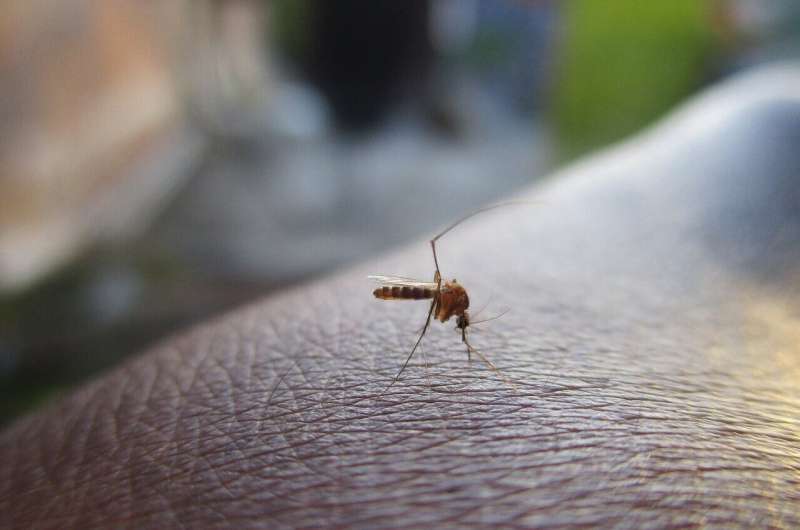
While West Nile remains the greatest mosquito-borne threat in Pennsylvania, state officials are monitoring another virus that has begun popping up in mosquito populations.
Jamestown Canyon virus, discovered in a Colorado town of the same name in 1961, was added to the state Department of Environmental Protection’s West Nile Virus Mosquito Monitoring Program just last year.
As of July 18, the commonwealth reported that 23 mosquitoes had tested positive for the virus. The most, 13, were found in Luzerne County, in northeastern Pennsylvania.
Closer to Pittsburgh, one mosquito tested positive for the virus in Westmoreland County.
While the case count is relatively low, the state has started to pay attention to Jamestown Canyon virus because, for some time, mosquito habitats and the illnesses associated with the insects are expanding into new areas. Climate change has engendered both warming temperatures and increased rainfall in many places, Pennsylvania included, said Elizabeth McGraw, head of Penn State University’s biology department and a specialist in mosquito-borne disease.
“For both mosquitoes and ticks, we know that climate change is massively altering the distributions of these animals and potentially also the distributions of the viruses. Because mosquitoes have their own temperature range that they’re comfortable with … then the viruses do too,” she said.
“It’s important for Pennsylvanians to know about mosquito-borne diseases, and that the landscape of those diseases are changing.” Climate change means that “residents of Pennsylvania might have to start thinking about pathogens that they’ve never considered before.”
Jamestown Canyon virus, which can be spread by multiple species of mosquitoes, can cause febrile illness—meningitis—and encephalitis, or inflammation of the brain, Ms. McGraw said. What sets it apart from many other mosquito-borne illnesses, she said, is that it can also cause respiratory symptoms.
What it does share in common with illnesses like West Nile is that many people who contract it don’t know they have it.
“Like all of these viruses, you can have people who have no symptoms. Or people who have mild symptoms.”
The disease often only gets reported if an infected individual requires hospitalization for severe symptoms, which would trigger more vigorous testing to determine what is ailing them.
While rest, fluids and pain medications may relieve symptoms, there is no specific treatment for Jamestown Canyon, Ms. McGraw said.
The virus circulates in the environment between mosquitoes and several different animals. In Pennsylvania, that typically means deer, but in other areas of the country, bison and moose carry the virus, too, she said.
Humans, however, are considered to be dead-end hosts, meaning that if a non-infected mosquito bites an infected person, the illness will not be transmitted to the mosquito.
The Department of Environmental Protection is monitoring the virus via mosquito population surveys, which are conducted by the agency and county workers. In southwestern Pennsylvania, those include Allegheny, Beaver, Butler, Westmoreland, Washington and Fayette counties, according to DEP spokesman Neil Shader.
Mosquitoes are captured and tested at the Harrisburg DEP lab, he said in an email.
Jamestown Canyon virus infects an average of 23 people annually in the U.S., with most cases being reported in upper Midwest states. Minnesota and Wisconsin account for more than half of reported cases, per the Centers for Disease Control and Prevention.
One human case was reported in Pennsylvania in 2013, and a horse tested positive for the virus in 2024, according to a DEP fact sheet.
From 2011 to 2024, there were more than 330 cases reported across the U.S., with 12 deaths attributed to the virus, per the CDC. The CDC had not recorded any human cases of the virus in 2025 as of July 15.
The fact sheet suggests that the best way to protect against Jamestown Canyon virus is to try to prevent getting bitten in the first place.
Eliminate standing water and stay away from flooded woodlands and meadows where deer are plentiful. Additionally, people are advised to wear long sleeves and pants, use insect repellent containing DEET, picaridin or lemon eucalyptus oil. It is also recommended to be mindful of time spent outdoors during dusk and dawn, peak activity times for mosquitoes.
2025 PG Publishing Co. Distributed by Tribune Content Agency, LLC.
Citation:
Biologists are tracking Jamestown Canyon virus, detected in Pennsylvania mosquitoes (2025, July 28)
retrieved 28 July 2025
from https://medicalxpress.com/news/2025-07-biologists-tracking-jamestown-canyon-virus.html
This document is subject to copyright. Apart from any fair dealing for the purpose of private study or research, no
part may be reproduced without the written permission. The content is provided for information purposes only.




