

Human Passport has unveiled a new verification method that allows individuals to prove they are real people using only email receipts — no crypto wallets, biometric scans, or onchain transactions required.
Partnering with zkEmail, Human Passport now offers a privacy-preserving “Stamp” that verifies a user’s personhood through real-world activity embedded in their inbox, such as Uber rides or Amazon purchases. It’s a novel blend of traditional email infrastructure and zero-knowledge cryptography, enabling proof of humanity that’s both secure and seamless.
Verifying Reality, Privately
The collaboration with zkEmail brings a unique technical innovation to the forefront. At the core of the system is the use of regular expressions — patterns used to detect text inside emails. zkEmail scans a user’s inbox for specific formats, such as, “an email sent from [email protected] to [email protected] containing a confirmation code.” A visual example, shared by the team, shows how such a pattern is detected, validated, and turned into a cryptographic proof — all without exposing any of the email’s content.
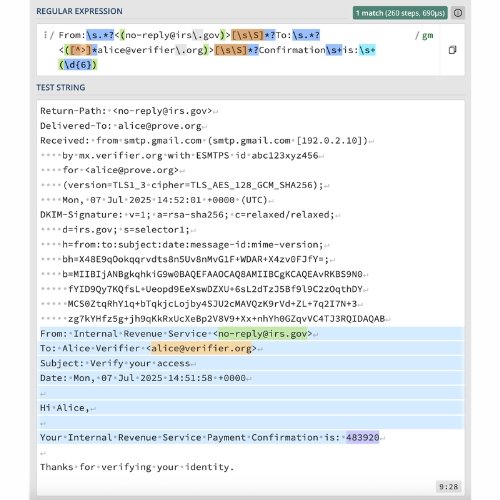
Importantly, the zero-knowledge proof parses only the pattern match, not the content. This ensures that receipts remain private and personal data is never extracted or seen, even by Human Passport or zkEmail. Additionally, the system checks the DKIM (DomainKeys Identified Mail) signature of the sender, verifying that only emails genuinely sent by the domain owner can be used.
“Proving you’re human should be simple and private, while always remaining secure and free… These additional Stamps honor that philosophy,” said Kyle Weiss, Co-Founder of Human Passport
Frictionless and Forgery-Proof
Once a match is verified, Human Passport instantly issues a digital credential — no blockchain transaction or gas fee required. The process uses a Trusted Execution Environment (TEE) with temporary, read-only Gmail access to perform the search. Users are awarded a “Stamp” reflecting the action, such as:
- Amazon: “Casual Purchaser” for 1+ orders, “Heavy User” for 50+ orders
- Uber: “Occasional Rider” for 3+ rides, “Power User” for 75+ rides
Each Stamp adds to a user’s “Humanity Score,” a cumulative measure used across the human.tech ecosystem. A higher score can unlock airdrop eligibility, community governance access, and other Web3 rewards. To date, Human Passport has issued over 35 million credentials to more than 2.2 million users, enabling $430 million in verified airdrop distributions.
Digital Identity in the Age of AI
As AI-generated content and synthetic identities proliferate, establishing human identity is becoming essential digital infrastructure. Current systems typically rely on blockchain activity or invasive biometric scans — approaches that can be exclusive, slow, or privacy-compromising.
This new email-based method flips that paradigm. “Proving you’re human should be simple and private, while always remaining secure and free,” said Weiss. “These additional Stamps honor that philosophy.”
The zkEmail protocol is also being expanded to support more platforms and inbox patterns in future releases. The vision is to eventually allow proof of broader digital behaviors — like subscriptions or logins — all while maintaining privacy and minimizing user friction.
Human Passport, formerly Gitcoin Passport, was acquired in 2024 by human.tech, a privacy-first identity platform built by Holonym. Human.tech is designing a digital future grounded in ethical tech — one where users can verify themselves and participate online without sacrificing autonomy or security.
Read Also: Lombard Eyes $6 Trillion On-Chain Bitcoin Economy with New Infrastructure Stack
Disclaimer: The information provided on AlexaBlockchain is for informational purposes only and does not constitute financial advice. Read complete disclaimer here.




