

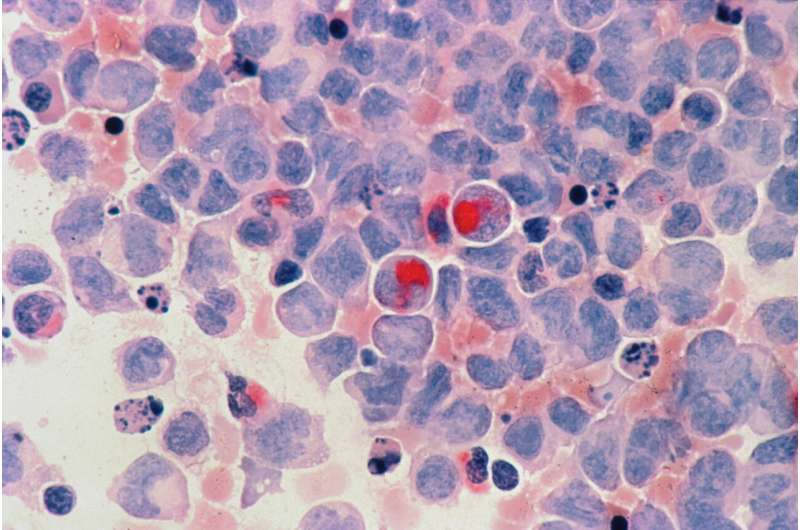
Researchers working on an incurable blood cancer can now use a new lab model that could make testing potential new treatments and diagnostics easier and quicker, new research has found.
In a paper published in Nature Communications, a team of researchers led by the University of Birmingham has studied blood cells from patients with a blood cancer called myelodysplastic syndrome disease (MDS). This disease often develops into a highly aggressive form of acute myeloid leukemia (AML).
Working with this new model has led to confirmation that a mutation in the gene CEBPA causes progression from MDS to AML.
Dr. Paloma Garcia, from the University of Birmingham and lead author of the study, said, “Our study using blood cancer cells from a patient with MDS before and after disease progression presents two exciting developments for a better understanding of the condition. Firstly, we developed a powerful and true-to-life model for future research using induced pluripotent stem cells (iPSCs) from an actual patient, which presents an exciting future for studying blood cancers as we are also able to recreate the mutations that led to the cancer.
“Secondly, the confirmation that the mutation of the CEBPA gene plays such an important role in disease progression presents a significant step towards new ways to treat and diagnose MDS and avoid more serious conditions. I believe that our new cell culture model could form the basis of elaborate drug screening experiments, which could help to find potential treatments for what is currently a highly aggressive blood cancer.”

Behaved just like patient’s real cells
The team set out to examine whether changes to the gene CEBPA were driving disease progression in patients with MDS, or whether mutations were a passenger as the blood cancer developed into the more serious AML.
The team took blood cells from a patient that was diagnosed with MDS and reprogrammed these cells into iPSCs using a genetic trick. Once obtained, these cells can give rise to any cell type of the body. They then used sophisticated cell culture methods to convert them into white blood cells and red blood cells in the lab. Using multiple tests, they showed that the lab-grown cells behaved just like the patient’s real cells.
Using patient cells that were obtained early during disease progression without the mutation, the researchers were then able to modify the cells’ genome to include the mutation in the CEBPA gene as it had happened in the patient two years after being diagnosed with MDS. This change made the disease more aggressive: it reduced the number of healthy cells, blocked the formation of white blood cells, and then aberrant cells were formed that divided more rapidly, even when they were treated with chemotherapy, mimicking what happened to the patient.
Prof Constanze Bonifer, a Birmingham Emeritus Professor and one of the senior authors on the paper, explained, “To show that this was true, we did not only study the behavior of the in vitro-generated cells, but also looked at how every gene in the cell population changed its activity. The experiments revealed that adding the CEBPA mutation to the mix of mutations that were already there alters how DNA is organized in blood cells, which completely changed gene activity and pushed the cells on the path to malignancy. “
Dr. Paloma Garcia, lead author of the study, said, “Using iPSC cells to model disease processes is a new and exciting way of understanding how blood cancers develop and will significantly expedite our ability to find novel treatments.”
More information:
Ruba Almaghrabi et al, A heterozygous CEBPA mutation disrupting the bZIP domain in a RUNX1 and SRSF2 mutational background causes MDS disease progression, Nature Communications (2025). DOI: 10.1038/s41467-025-60192-8
Citation:
Incurable blood cancer tied to gene mutation in new lab model (2025, July 3)
retrieved 3 July 2025
from https://medicalxpress.com/news/2025-07-incurable-blood-cancer-gene-mutation.html
This document is subject to copyright. Apart from any fair dealing for the purpose of private study or research, no
part may be reproduced without the written permission. The content is provided for information purposes only.




