

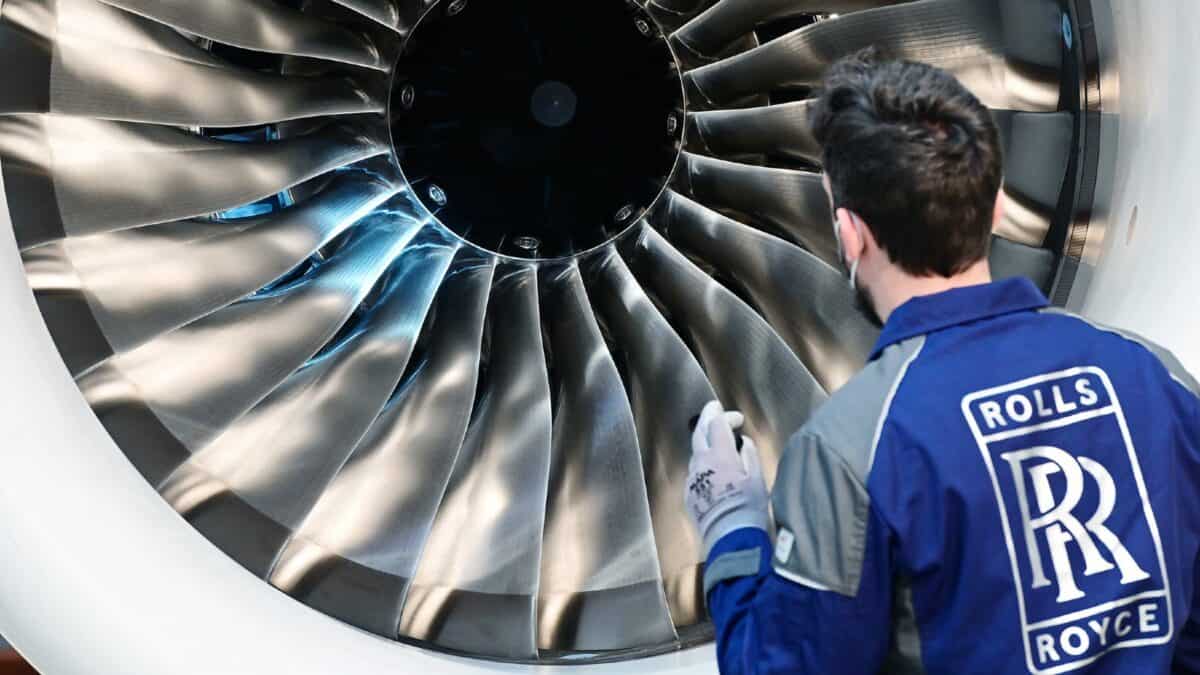
Image source: Rolls-Royce plc
With the war in Iran causing huge problems for the global aviation industry, it’s not surprising that the Rolls-Royce Holdings (LSE:RR.) share price has been falling. As recently as March, the group’s shares were changing hands for over £14. Now (5 May), one could be bought for around a fifth less.
Clearly, the rising cost of jet fuel resulting from a lack of supply is taking its toll on airlines. Lufthansa has announced that it will cut 20,000 European short-haul flights over the summer. Others have made similar decisions. Rolls-Royce generates revenue every time one of its engines is used. Fewer flights will likely reduce earnings. But are investors being overly cautious?
Nothing to see here
Based on the group’s 30 April trading update, it appears they may be.
Ahead of its annual general meeting, the group said it expected to “fully mitigate” the current financial impact of the disruption. Perhaps surprisingly, there was no mention of what might happen if the conflict continued. The update was very bullish.
Indeed, large engine flying hours increased by 5% during the first quarter of 2026. And while Lufthansa’s decision to cancel flights sounds dramatic, it has to be remembered that the German airline currently operates around 3,000 a day.
Some of Rolls-Royce’s ability to cope with the fallout from the war can be attributed to the fact that it’s not a one-trick pony.
As well as its aerospace division, it has significant exposure to the defence and power systems sectors. Both of these had a “strong start to the year”. The latter reported a record month for orders in March. Data centres and government were the biggest contributors.
Business as usual
Looking further ahead, its small modular reactor (SMR) programme remains on schedule. Rolls-Royce boasts that it’s “the only company with multiple contractual commitments to deliver SMR units in Europe and is well placed to become a market leader globally.”
Overall, the group reiterated its 2026 guidance of £4bn–£4.2bn of underlying operating profit and £3.6bn–£3.8bn of free cash flow. For comparison, in 2025, these were £3.5bn and £3.3bn, respectively.
We have had a strong start to the year driven by our transformation and self-help, as we continue to further expand the earnings, cash, and growth potential of the business. Operational performance has also been strong across the Group, benefiting our customers.
Tufan Erginbilgic, Chief Executive, Rolls-Royce Holdings
My view
In my opinion, the group’s shares are well worth considering by those investors with a long-term outlook.
Of course, there could be some bumps along the way. Despite the group’s optimism, there’s bound to be some impact on its civil aerospace business if the blockade of the Strait of Hormuz continues. And even after the recent pullback, I don’t think the group’s shares can be described as cheap.
However, it has exposure to markets that are all performing strongly for different reasons. This helps spread operational risk. But if all three grow at the same time — as they are at the moment – there’s a good chance that Rolls-Royce will be in a position to upgrade its earnings and cash flow forecasts yet again.
I think last week’s trading update demonstrates the resilience of the business and should reassure investors that it’s well positioned to cope with any short-term disruption that comes its way.
Source link




