

Image source: Getty Images
A big dividend yield can be a huge opportunity. But it can also be a sign that other investors are worried about something.
Legal & General‘s (LSE:LGEN) a good example. The stock comes with an 8.4% yield, but investors need to think why?
Returns
Five years ago, Legal & General shares were trading at 296p. Since then, investors have received 98.28p per share in dividends. Unfortunately, the stock’s fallen 36.3p. So the net gain is 61.98p, or around 21% – well below the FTSE 100 average.
Why is this? One reason is that the company’s book value – the difference between its assets and its liabilities – has been falling.
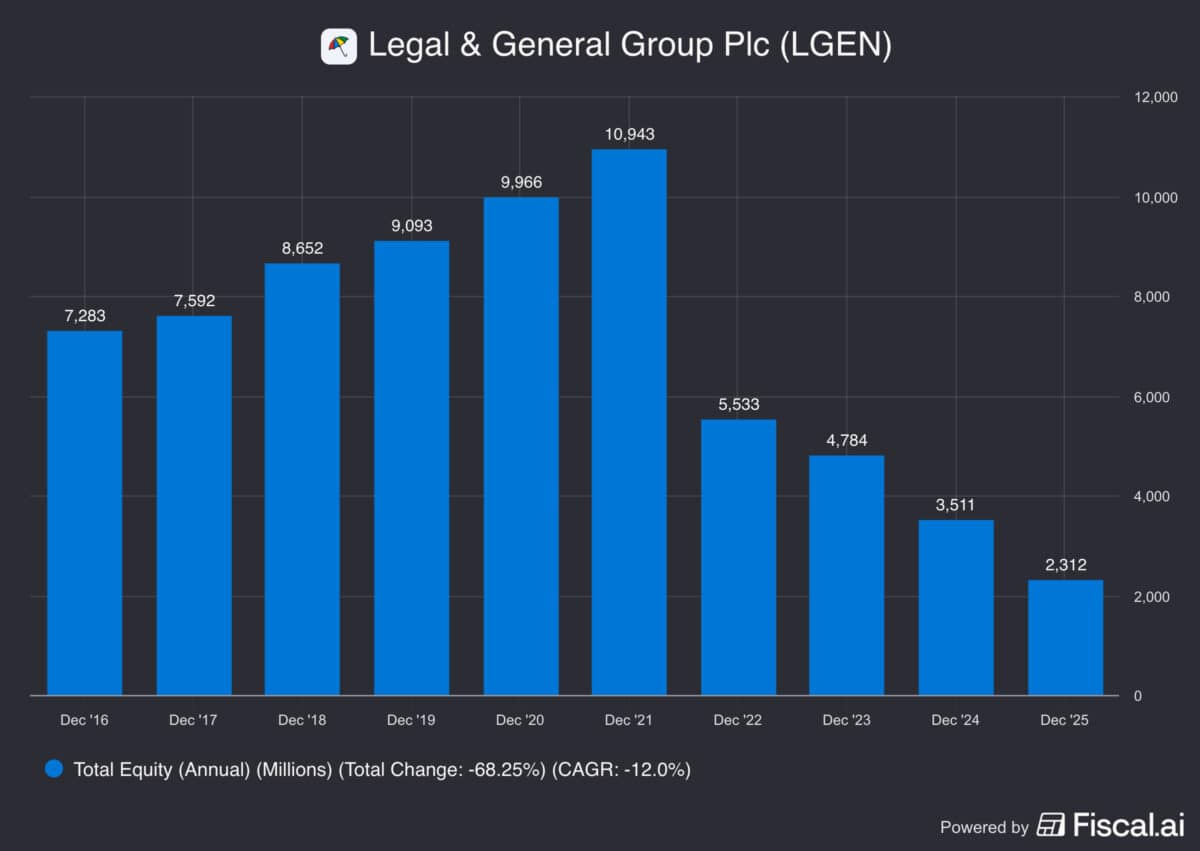
A good amount of this is the direct consequence of the dividend. As the firm returns cash to investors, those assets leave the balance sheet.
In 2025, Legal & General distributed £1.25bn in dividends. And the firm’s book value fell from £3.51bn to £2.31bn.
The thing is, there’s more to this company than its book value. Investors also need to look at something called the Contractual Supply Margin (CSM).
Contractual Supply Margin
When Legal & General wins an annuity contract, it gets the premiums up front. But they don’t show up on its balance sheet straight away. The profits are added during the life of the policy. Each year, a bit more appears as long as the firm’s investments stay ahead of its payouts.
The CSM is the store of profits set to be added in the future. And the change in this is just as important as the book value. In 2025, this actually grew by £200m. That’s despite Legal & General moving around £1bn to its balance sheet in operating income.
If that sounds complicated — good. And there’s plenty more to account for in terms of interest rates and risk adjustments. That, however, is why the dividend yield is so high. Investors can think of it as compensation for taking certain hard-to-assess risks.
Underwriting and investing
In some ways, Legal & General’s insurance operation is like its stock. Both involve a process of getting paid to take on risks. The firm’s business involves getting paid premiums to take on future liabilities. And it has to figure out whether or not it’s worth it.
Something similar is true for investors. Anyone who buys Legal & General shares gets a dividend in exchange for owning part of the business. The investor’s job is to figure out whether or not it’s worth it. And this involves assessing quite a lof of things.
These include changes in interest rates and the impact of people living longer. But those are very difficult to evaluate. That’s a big part of why the dividend yield is high. Investors rightly want to be compensated for taking risks they can’t easily assess.
Too hard
Legal & General’s 8.4% dividend yield isn’t free money. It’s a risk premium for investing in an extremely complicated business.
Is it high enough? It’s hard to tell – the company’s balance sheet doesn’t even tell the full story about what’s going on. As billionaire investor Warren Buffett says, risk comes from not knowing what you’re doing. And for most people – including me – that’s the case here.
Fortunately, there are quite a few other stocks that are more straightforward. One or two of them even come with similar dividend yields.




